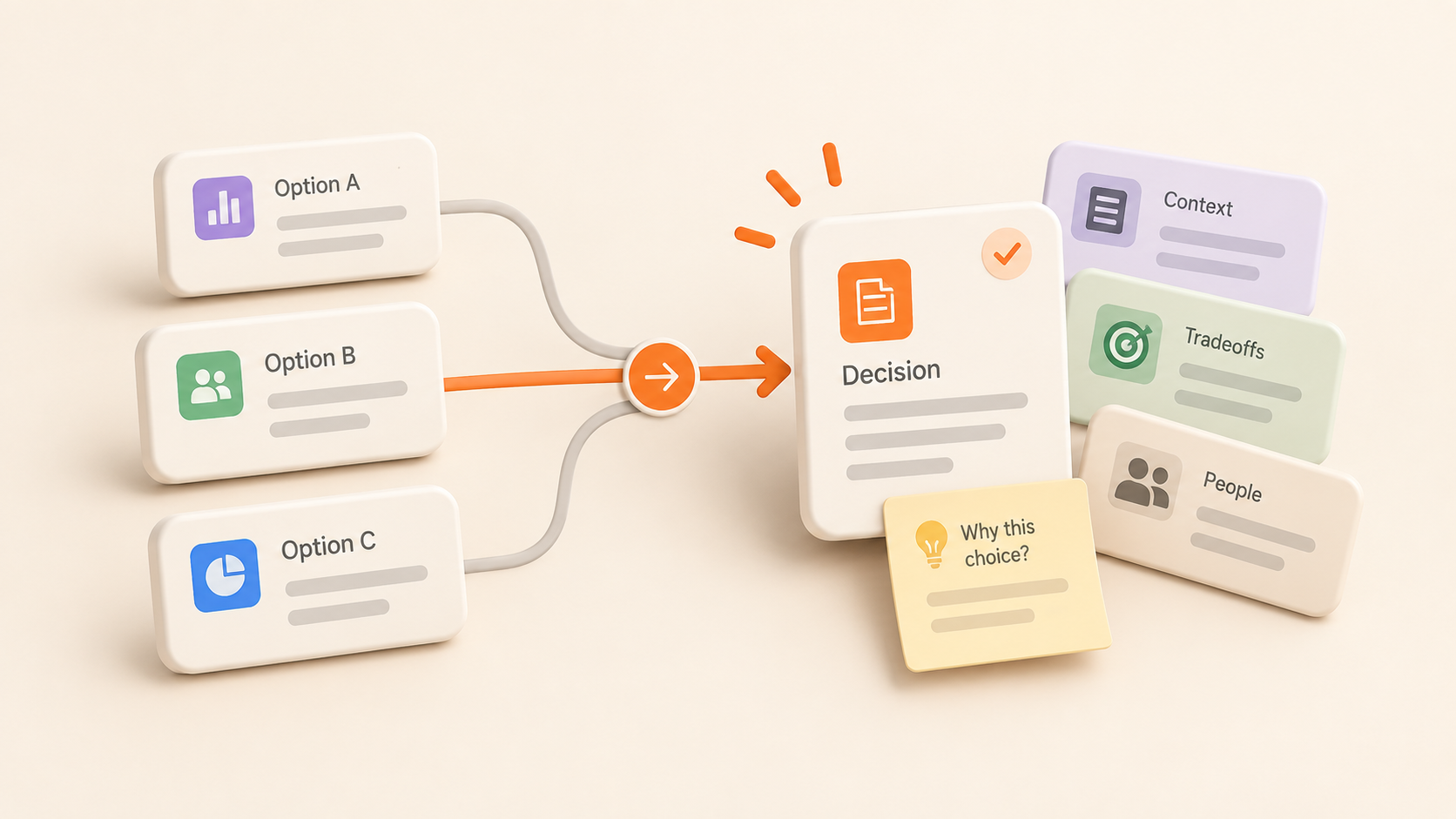
Your team decides to change a process, adjust the scope of a project, or choose one technical approach over another.
At the time, everyone involved knows why.
Three months later, someone asks why the team made that choice. The answer is buried in meeting notes, scattered across comments, or sitting in the memory of the people who were there.
The decision itself is only part of what was lost. The reasoning behind it is usually more valuable.
Good decision documentation gives future readers enough context to understand what happened without reconstructing the original conversation.
A decision needs more than an outcome
Writing down "We chose option B" records the result, but it doesn't explain much.
Useful decision documentation should answer a few basic questions:
What did we decide?
Why did we need to make this decision?
What options did we consider?
Why did we choose this option?
When was the decision made?
Who was involved?
Not every decision needs a detailed record. A small operational choice might only need a sentence or two. A technical or product decision with long-term consequences deserves more context.
The useful test is whether someone unfamiliar with the original discussion could understand the choice later.
Capture the context while it's still obvious
Context tends to disappear faster than the decision itself.
Imagine a team decides to delay a feature because an underlying technical dependency isn't ready. Six months later, the roadmap might only show that the feature moved.
Without the original context, someone could reasonably assume it was deprioritized, too expensive, or simply forgotten.
A short explanation changes that:
We moved the feature to the next release because it depends on the new permissions system. Shipping it beforehand would require an implementation we'd replace shortly afterward.
Now the decision makes sense even to someone who wasn't there.
You don't need to preserve every argument or reproduce the meeting. Capture the information that explains why the outcome was reasonable at the time.
Record the alternatives that mattered
Decisions usually involve options, even when those options aren't formally presented.
Recording the alternatives helps future readers understand the tradeoffs.
For example:
Decision: Use a single onboarding flow for all new accounts.
Considered: Separate onboarding flows based on team type.
Reasoning: We don't yet have enough differences between team types to justify maintaining multiple flows. We can revisit this if their onboarding needs diverge.
This is more useful than simply recording the final choice.
It also prevents an old idea from being rediscovered later as though nobody had considered it before. Someone can see that the option was discussed, why it wasn't chosen, and whether the assumptions behind that choice still apply.
Put decisions close to the work they affect
A perfectly maintained decision log isn't very useful if nobody thinks to look at it.
Where a decision lives affects whether people will find it later.
A decision about an engineering project is usually more useful near that project's specifications and technical documentation than inside an unrelated archive of company-wide decisions. The same applies to product decisions, operational processes, and client work.
In Notework, Projects give related work a shared home. Pages can hold specifications, meeting notes, policies, decisions, and other written knowledge, while Collections can be used for structured work such as issues, tasks, and roadmaps.
That makes it possible to keep a decision in the same broader context as the work it affects instead of separating the reasoning from the implementation.
The important principle applies regardless of the tool: organize decisions according to where someone is likely to need them.
Make individual decisions easy to identify
A page called "June 12 meeting notes" might contain an important decision. Someone searching for that decision months later probably won't remember the meeting date.
If a decision matters beyond the meeting where it happened, make it identifiable on its own.
That could mean creating a dedicated page for a significant decision or giving the relevant section of a larger document a clear heading.
Prefer titles such as:
Authentication approach for mobile
Q4 pricing model decision
Customer data retention policy
Decision to consolidate onboarding flows
The title doesn't need to explain the entire decision. It should give someone enough information to recognize it in navigation or search.
Notework's hybrid search works across Pages, Collection entries, comments, and attachment names using both meaning and keywords. Descriptive titles and clear language still matter. Search works better when the underlying documentation says what it actually contains.
Distinguish current decisions from old ones
Decisions change.
A team might choose one approach in January and replace it with another in September. The January record can still be useful because it explains why the original choice was made, but readers also need to know that it no longer represents the current direction.
Deleting the old decision removes useful history. Leaving it untouched can create confusion.
Instead, make the change explicit.
You might add a short note such as:
Status: Superseded
Replaced by: Updated authentication approach
Then link or point readers to the newer decision where possible.
Notework Pages include version history, so teams can also see how a document has changed over time. But document history and decision history aren't quite the same thing. If the decision itself changes, say so in the content rather than expecting someone to infer it from previous versions.
Don't document every decision
If recording a decision takes longer than making it, your system probably won't last.
Not every choice needs a permanent record.
It's usually worth documenting a decision when:
It affects work beyond the people in the original conversation.
Someone is likely to ask why the choice was made later.
Reversing it would have meaningful consequences.
Several reasonable alternatives existed.
The reasoning depends on constraints that might change.
It establishes a process, policy, or technical direction.
Choosing the wording of a button probably doesn't need a formal decision record. Choosing a new authentication approach probably does.
The goal is useful organizational memory, not a transcript of every choice your team makes.
Use a simple decision format
Consistency makes decision records easier to scan, but the format doesn't need to be complicated.
A lightweight template might look like this:
Decision
What did we decide?
Context
What problem or situation required a decision?
Options considered
What realistic alternatives did we discuss?
Reasoning
Why did we choose this option? What tradeoffs mattered?
Date and participants
When was the decision made, and who was involved?
Status
Is this decision current, superseded, or being reconsidered?
For smaller decisions, several of these sections can be a sentence long. For significant technical, product, or organizational decisions, they can hold more detail.
The format should serve the decision, not become paperwork for its own sake.
The goal is to preserve reasoning, not meetings
Teams already produce plenty of information. Meeting notes, comments, specifications, tasks, and messages all capture pieces of what happened.
The difficult part is preserving the pieces that will still matter later.
A useful decision record turns "I think we discussed this once" into something another person can actually find and understand. It preserves the outcome, but also the context and tradeoffs that made the outcome sensible.
In Notework, Pages can hold that written record, Projects can keep it close to related work, and Collections can keep structured work alongside the documentation when needed.
You don't need to document every conversation.
Document the decisions your team will eventually need to understand again.
How to Document Decisions So Your Team Can Find Them Later — Notework Blog