An issue says, "New users can't complete onboarding on mobile."
Both represent work that someone needs to deal with. Both might have an owner, a status, and a place in the same project. So does it actually matter what you call them?
Sometimes, yes.
There isn't one universal definition of a task or an issue. Different teams and tools use the terms differently. But making a useful distinction between them can help your team understand not only what needs attention, but why the work exists in the first place.
A task usually describes work you intend to do
A task is generally an action with a defined outcome.
For example:
Update the pricing page
Review the Q4 roadmap
Prepare the customer interview questions
Add the new field to the signup form
Write documentation for the API change
The work may be large or small, but the item describes an action.
Tasks often come from planning. Your team decides what needs to happen and creates tasks to represent that work.
A useful way to think about a task is:
What needs to be done?
If the answer is clear, you're probably looking at a task.
An issue usually starts with something that needs attention
An issue often describes a problem, unexpected behavior, question, or situation that needs to be investigated or resolved.
For example:
Signup form fails on Safari
Customer can't upload a profile image
Search results include archived content
Mobile navigation overlaps the page title
Unlike a task, the required action might not be obvious when the issue is created.
"Fix signup form on Safari" assumes you already know what the solution involves.
"Signup form fails on Safari" records the problem first. Someone can investigate the cause, decide what needs to change, and then resolve it.
A useful question for an issue is:
What's happening that requires attention?
The difference is often intent versus observation
The distinction becomes clearer when you compare similar items.
Task: Add an error message to the payment form.
Issue: Payment form fails without explaining what went wrong.
The task describes an action. The issue describes the situation that created the need for action.
Issue: Navigation covers the page title on smaller screens.
Again, one tells you what to do. The other tells you what's wrong.
That doesn't mean every issue needs to become a separate task. A small issue might be investigated and resolved directly. A larger issue could produce several tasks once the team understands the solution.
The useful distinction is in what the item represents.
Issues often need more context before they need a solution
When someone creates a task, they can often describe the expected result immediately.
Issues tend to need more evidence.
A useful issue might include:
What happened
What was expected instead
Where the problem occurred
Steps or conditions that reproduce it
Screenshots or other relevant context
How significant the problem appears to be
The exact information depends on the team. A software bug and an operational issue won't need identical fields.
The principle is simpler: record enough context for someone else to understand the problem without having to rediscover it.
Only then does it make sense to decide what should be done.
Tasks benefit from a clear outcome
Tasks have a different documentation problem.
"Work on onboarding" is technically an action, but it doesn't tell the person responsible what finishing the task looks like.
"Rewrite the three onboarding steps for new team accounts" gives the work a clearer boundary.
A useful task should make the expected outcome understandable. Depending on the work, that might include a short description, relevant context, an owner, a due date, or acceptance criteria.
You don't need to turn every task into a specification. You need enough information for the person doing the work to know what "done" means.
One issue can lead to several tasks
This is where the distinction becomes particularly useful.
Imagine customers report that a settings page is difficult to use on mobile.
The team creates an issue:
Issue: Settings page is difficult to use on small screens.
After investigating, the team decides the solution requires several changes:
Tasks:
Update the responsive layout
Adjust the navigation behavior
Increase spacing around form controls
Test the revised page on supported screen sizes
The issue preserves the original problem. The tasks describe the work chosen to address it.
That separation can be valuable later. Someone looking back can understand not only what the team changed, but what prompted the changes.
Not every team needs a strict distinction
For a small team, separating tasks and issues may create more process than value.
If most tracked items are straightforward and everyone understands the context, putting everything into a single list can work perfectly well.
The distinction becomes more useful when the volume or variety of work increases.
An engineering team might want to distinguish bugs from planned implementation work. A support team might track reported problems separately from follow-up tasks. A product team might want to preserve the original issue even when resolving it requires several pieces of work.
The goal isn't to create more categories.
It's to make the categories you use tell people something useful.
Tasks and issues can still live in the same system
Different types of work don't necessarily need completely separate tools.
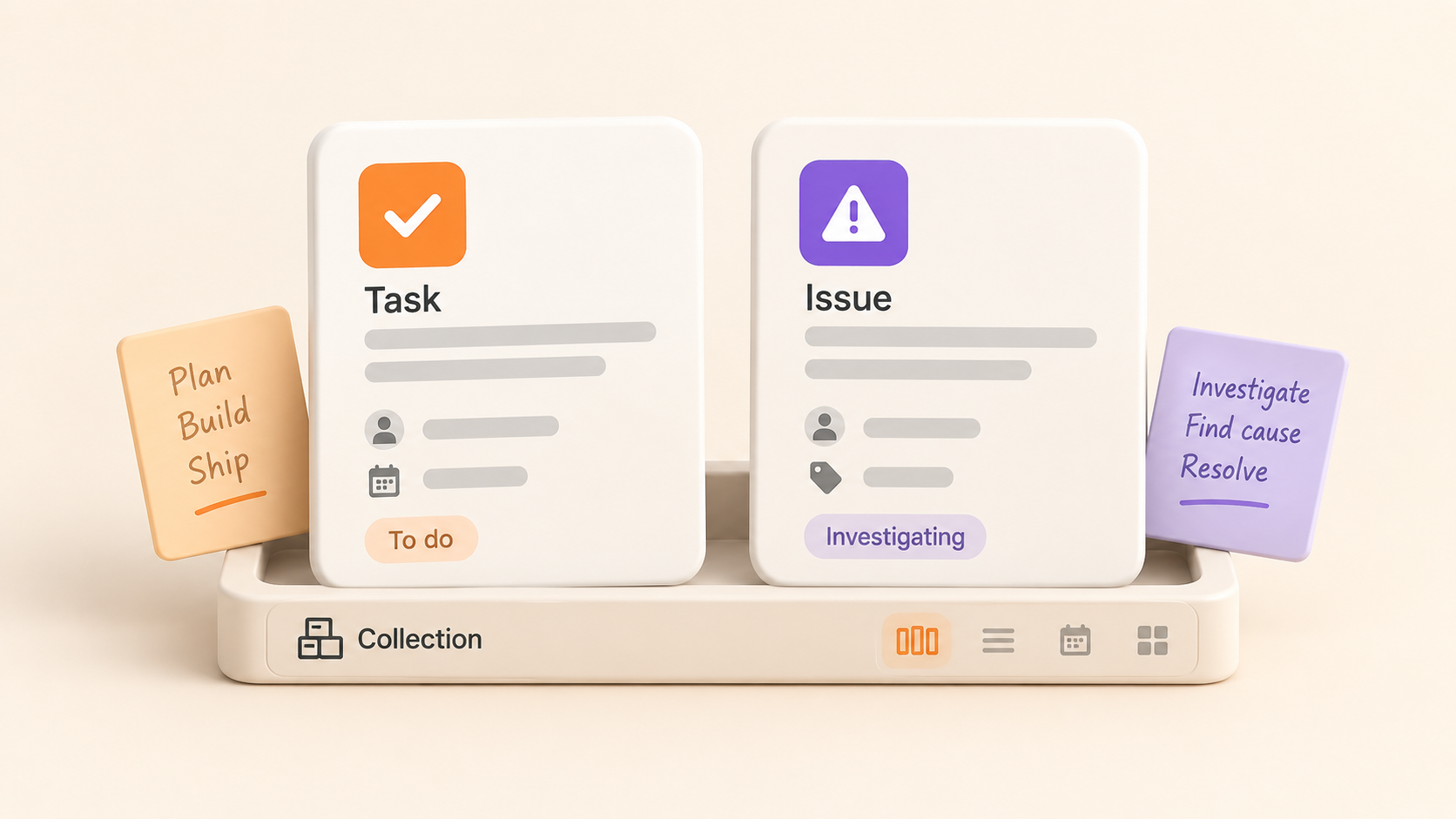
In Notework, Collections are used for structured work such as tasks, issues, roadmaps, and other operational work. Collections can be viewed as boards, tables, lists, calendars, timelines, and galleries, so teams can organize tracked work according to what they're managing.
That means the useful question isn't necessarily, "Which tool should we use for tasks and which tool should we use for issues?"
It's how your team wants to structure the work and what information each type of item needs.
You might keep tasks and issues in different Collections when their workflows are meaningfully different. Or you might use a simpler structure when separating them doesn't add much value.
Use the distinction when it adds information
Calling something a task or an issue should make the work easier to understand.
A task usually describes an action to complete.
An issue usually describes a situation that needs attention or resolution.
That distinction can help preserve the difference between a problem and the work chosen to solve it. But it doesn't need to become a rigid rule.
If your team benefits from separating the two, define what each term means and use it consistently. If it doesn't, keep the workflow simpler.
The useful system is the one where someone can look at an item and quickly understand what they're being asked to deal with.