How to Reduce Key Person Risk Without Documenting Everything
Updated Oct 14, 202610 min read
A customer renewal is due Friday. Sam usually handles it, but Sam is unavailable. Nobody knows which terms were promised, who can approve a discount, or where the latest conversation lives.
“Sam handles renewals” felt like ownership until someone else had to do the work.
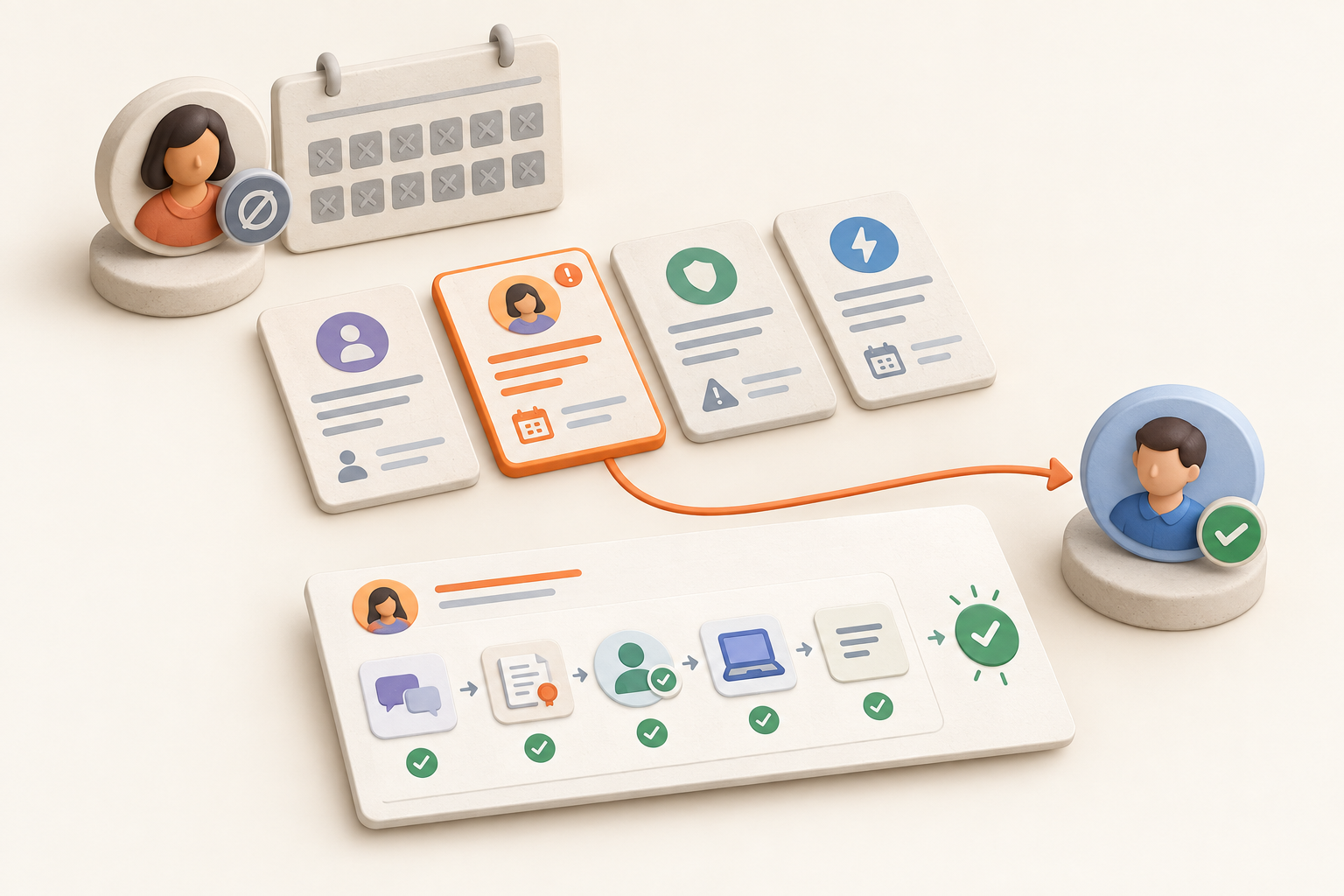
Reducing key person risk does not require a complete manual for every role. Start with the responsibilities that would create real trouble during a two-week absence. Assign a capable backup, then give that person a short path through the next cycle.
Key person risk is the business exposure created by depending heavily on one person or a small number of people. The dependency may involve knowledge, technical skills, system access, judgment, customer relationships, or some unhelpful combination of all five.
Founders and executives are obvious candidates, but seniority is a poor way to find every risk. A support specialist may be the only person who understands a sensitive customer account. An operations coordinator may control access to a billing system. One marketer may know how the weekly campaign report is assembled and which odd-looking numbers are expected.
The practical concern is simple: which important work becomes unsafe, late, or impossible when its usual owner cannot help?
Choose one team member and assume they become completely unavailable tomorrow for two weeks. There is no tidy handoff, and the team cannot message them with “one quick question.”
List anything that would:
Two weeks is a practical exercise, not a universal risk-management standard. It is long enough to expose recurring work and near-term obligations while staying concrete enough to avoid drifting into every possible disaster scenario.
Run the test person by person. Asking “Who are our key people?” tends to produce a list of senior employees. Asking “What would fail if Priya disappeared for two weeks?” produces responsibilities you can fix.
Calendars reveal some recurring work, but many dependencies hide between the appointments. Check for:
Look at recent work too. Which requests caused someone to say, “Ask Jordan, they know how that works”? That sentence is practically a tiny risk assessment.
Useful knowledge is abundant. Critical responsibilities are bounded by consequences and time.
Prioritize a responsibility when it has a near-term trigger, meaningful customer or operational impact, context that would be difficult to reconstruct, restricted access, or decisions that another person could not safely make.
A preferred meeting format can wait. The only process for approving payroll probably cannot. A detailed history of every vendor discussion may be unnecessary, while the current contract owner, renewal date, login location, and cancellation deadline could matter quite a lot.
Selective documentation stays maintainable. The team’s time is better spent keeping a few important takeover paths accurate than creating a magnificent archive nobody trusts. The same principle applies when you organize project documentation or build an internal wiki that stays useful.
Create one inventory item for each critical responsibility found during the absence test. Keep it focused on work whose failure would matter.
| Field | What to capture |
|---|---|
| Responsibility | A specific outcome, such as “Complete Acme renewal” |
| Primary owner | The person who normally handles it |
| Backup owner | The person expected to take over |
| Trigger or cadence | The deadline, event, or recurring schedule |
| Risk if missed | The likely operational or customer consequence |
| Access needed | Systems, accounts, files, permissions, or physical access |
| Decision boundaries | What the backup can decide and what requires approval |
| Warning signs | Conditions that suggest the normal path is failing |
| Status | Uncovered, drafted, tested, or needs review |
| Review date | When someone should confirm that the entry remains accurate |
| Takeover page | A link to the short instructions and related context |
Avoid broad entries such as “finance” or “customer management.” Those labels hide several responsibilities with different triggers and backups. “Approve the twice-monthly payment run” is something a backup can understand and test.
A weak inventory entry says:
Responsibility: Acme renewal
Owner: Sam
Notes: Sam handles it.
An actionable entry might say:
Responsibility: Complete Acme’s annual renewal
Primary owner: Sam
Backup owner: Lena
Trigger: Begin 30 days before the renewal date
Risk if missed: Renewal may be delayed and agreed terms may not be reflected
Access needed: Contract folder, customer correspondence, billing system
Decision boundary: Lena can use the previously agreed terms; other changes need commercial approval
Warning signs: Customer requests new legal terms or disputes the account total
Takeover page: Acme renewal instructions and context
The second version gives Lena somewhere to begin. The linked takeover page holds the detail that does not belong in inventory fields.
A takeover page should help the backup complete the next cycle safely. It does not need to explain the primary owner’s entire role, professional history, or personal philosophy about renewal emails.
Use this compact structure:
For the renewal example, the first line could be:
Open the current agreement 30 days before renewal, confirm the commercial terms against the latest customer correspondence, and send the draft to the account owner for review.
That is already more useful than six pages of background followed by no obvious next action.
Procedures often capture the easy part: open this system, select that account, upload this file. A backup usually gets stuck when reality departs from the happy path.
Record the exceptions that change the decision. For example:
Explain internal acronyms and system names that an occasional backup may not recognize. When a decision needs context, document it so your team can find it later. An internal team glossary can also save everyone from decoding the same alphabet soup.
A named backup is only useful if they have enough familiarity to act, enough capacity to cover the work, and permission to make the expected decisions. Naming the least busy person on the org chart does not produce those conditions.
Choose someone close enough to the work that the handoff is plausible. Then verify:
Access deserves special attention. Discovering that the backup needs an account controlled by the absent person is a very avoidable plot twist.
A documented backup plan is still a hypothesis. Have the backup run one real cycle while the primary owner observes. If that is impractical, give them a realistic scenario and ask them to identify the next action, required context, decision boundary, and escalation path.
The primary owner should avoid supplying hints unless the backup is genuinely blocked. Missing permissions, stale links, unexplained terms, ambiguous thresholds, and “I would just ask you” all reveal useful gaps.
Update the takeover page from the test. The aim is a successful handoff, not a passing grade for the person who wrote the instructions.
Update an inventory item when its owner, backup, system, access requirements, or process changes. Add a lightweight periodic review for anything that remains critical, and remove items that no longer create meaningful risk.
Do not require everyone to reread every takeover page on a fixed schedule regardless of whether the work changed. Review attention should follow risk and change. A high-impact monthly process deserves more attention than a low-impact responsibility triggered once in a great while.
Keep the boundary firm. Document responsibilities that would cause meaningful trouble during an absence. Leave useful but noncritical knowledge alone until there is a reason to capture it. That is the point of a minimum viable process, not a documentation side job with its own documentation side job.
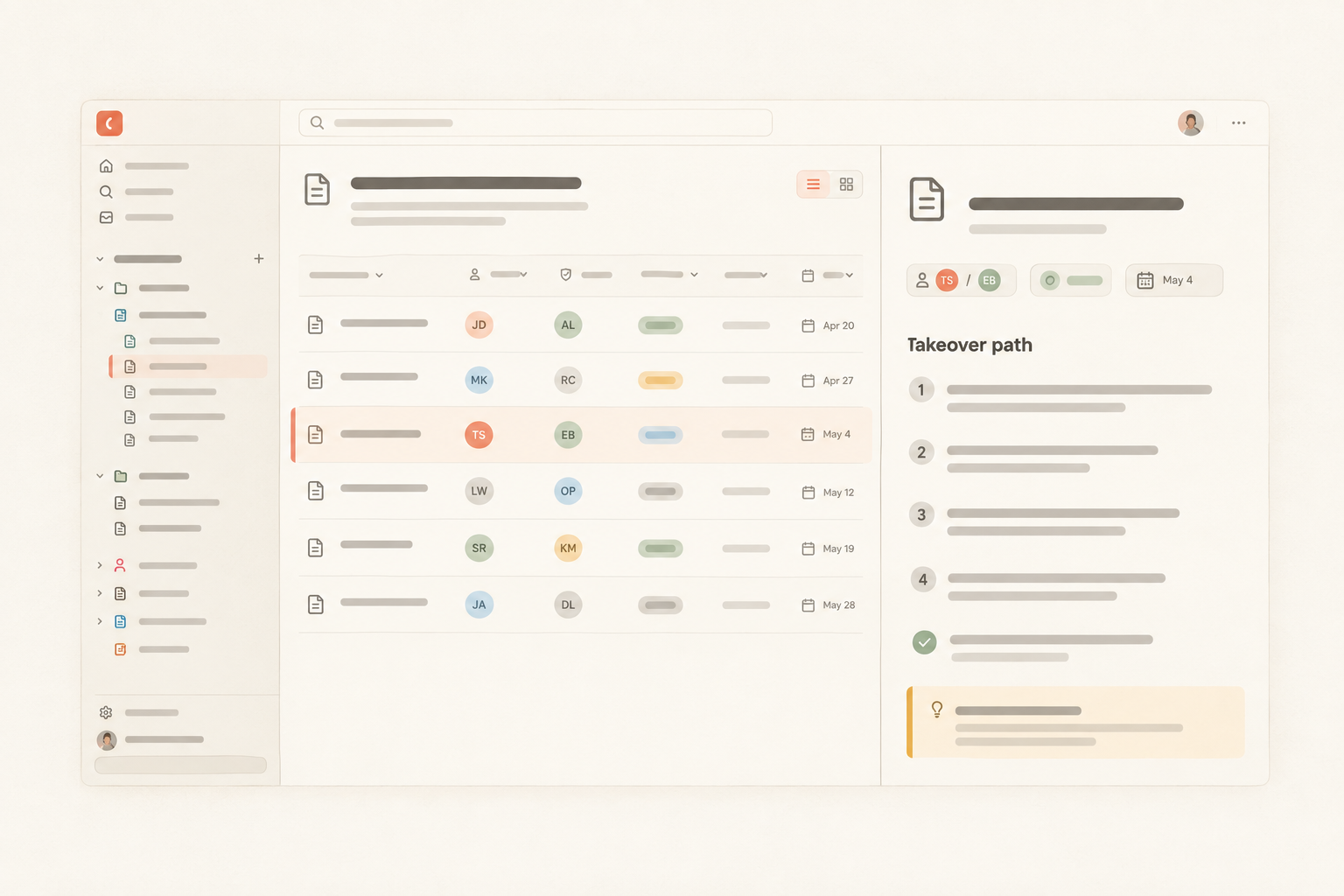
The method works in any shared documentation tool. The important part is the relationship between each responsibility, its backup, and the short page that explains how to take over.
If your team uses Notework, make the inventory a collection in the project where the operational work lives. A Notework workspace contains projects, and every page and collection belongs to a project. That gives the responsibility inventory a clear home instead of dropping it into an undifferentiated page tree.
Create a Critical responsibilities collection with properties such as:
Each collection item is a full entry page. Put the takeover path on that entry page, with nested pages, mentions, backlinks, and block-anchored comments when the instructions need supporting context or review.
Use a Table view for the main inventory. A Board view grouped by readiness can expose responsibilities that still lack a tested backup, while a Calendar view can show upcoming review dates. These are views of the same entries, not duplicate inventories.
Notework search combines exact matching with semantic retrieval, and results are trimmed to content the person can access. That matters when a backup remembers the customer situation or decision but not the exact title of the takeover page.
Notework is optional here. Its simpler, more opinionated Workspace to Project to Page and Collection model fits a small team that wants the inventory and its instructions together without maintaining an elaborate workspace. The two-week absence test remains the useful part, wherever the team keeps the result.
Pick one person and run the two-week absence test. Record only the responsibilities whose failure would matter. Choose one realistic backup, write the smallest useful takeover path, and ask that person to test it.
The first gap you find will probably be more useful than a month spent trying to document everything.
See also organize project documentation.
See also document decisions so your team can find them later.
See also build an internal wiki that stays useful.
See also minimum viable process.