
Minimum Viable Process: When a Startup Habit Needs More Structure
Updated Sep 22, 202610 min read
A task happens once, so someone handles it in Slack. Then it happens again. By the fifth time, nobody remembers who handled it last, which steps mattered, or why the team made a particular choice.
A minimum viable process adds just enough structure to make recurring work dependable. No miniature bureaucracy required.
This article uses minimum viable process to describe an internal team process. It is distinct from a minimum viable product, although some people use the phrase for the iterative process of developing and improving an MVP. This guide is about operating habits, not product scope.
The sources reviewed here are practitioner commentary rather than formal research or standards guidance. One useful principle is that minimum viable process can involve removing unnecessary process as well as adding structure.
The four-part test below is editorial guidance, not a validated scoring system. Use it to make a sensible judgment about a specific recurring activity.
Any new process should prevent a concrete failure. Perhaps customer commitments keep getting missed. Maybe launch details disappear during handoffs, or expenses get approved without enough context. “We should be more organized” is too vague. Name the failure first.
Consider frequency, handoffs, mistake cost, and reversibility. You do not need to assign points. More exposure to repeated or consequential failure usually supports adding more structure.
| Question | Less need for structure | More need for structure |
|---|---|---|
| How often does it happen? | Rare or one-off | Repeated often enough that people recreate the work |
| How many handoffs are involved? | One person handles it | Work crosses people or functions |
| What does a mistake cost? | Minor inconvenience | Customer impact, rework, missed commitments, financial cost, or reputational damage |
| How hard is it to undo? | Easy and inexpensive to correct | Difficult, expensive, or embarrassing to reverse |
A one-time task rarely needs reusable instructions. Writing and maintaining them may take longer than doing the task.
Repeated work is different. If a team prepares an announcement every month, answers the same onboarding questions for each hire, or regularly handles similar customer issues, relying on memory creates avoidable variation. A short reference can save everyone from reconstructing the approach each time.
Frequency alone does not justify a process. A harmless task done every Friday might still work perfectly well as an informal habit.
Low-risk work completed by one person can often stay in that person’s head. Handoffs expose the gaps.
Consider a campaign announcement that moves from marketing to product, then to legal review, and back to marketing for publication. Each handoff raises practical questions: What has already been decided? Who acts next? Which version is current?
As work crosses boundaries, shared context and clear ownership become more useful. Most teams do not need a complicated approval chain. They need an obvious next step.
Assess the actual consequence rather than calling everything important. A typo corrected five minutes after publishing differs from sending customers the wrong price or missing a contractual commitment.
A mistake might cause:
Ask which specific mistake the proposed process would prevent. If nobody can answer, leave the work alone for now.
Reversible choices deserve room for speed and judgment. An internal draft can be changed. A small experiment can be stopped.
Publishing customer-facing information, approving spending, deleting data, or changing a live process may be harder to correct. These actions can justify a check before completion, even when they happen infrequently.
Reversibility also affects the intervention. A reminder may cover an easy correction. A checklist is more appropriate when one skipped step creates a mess that takes days to unwind.
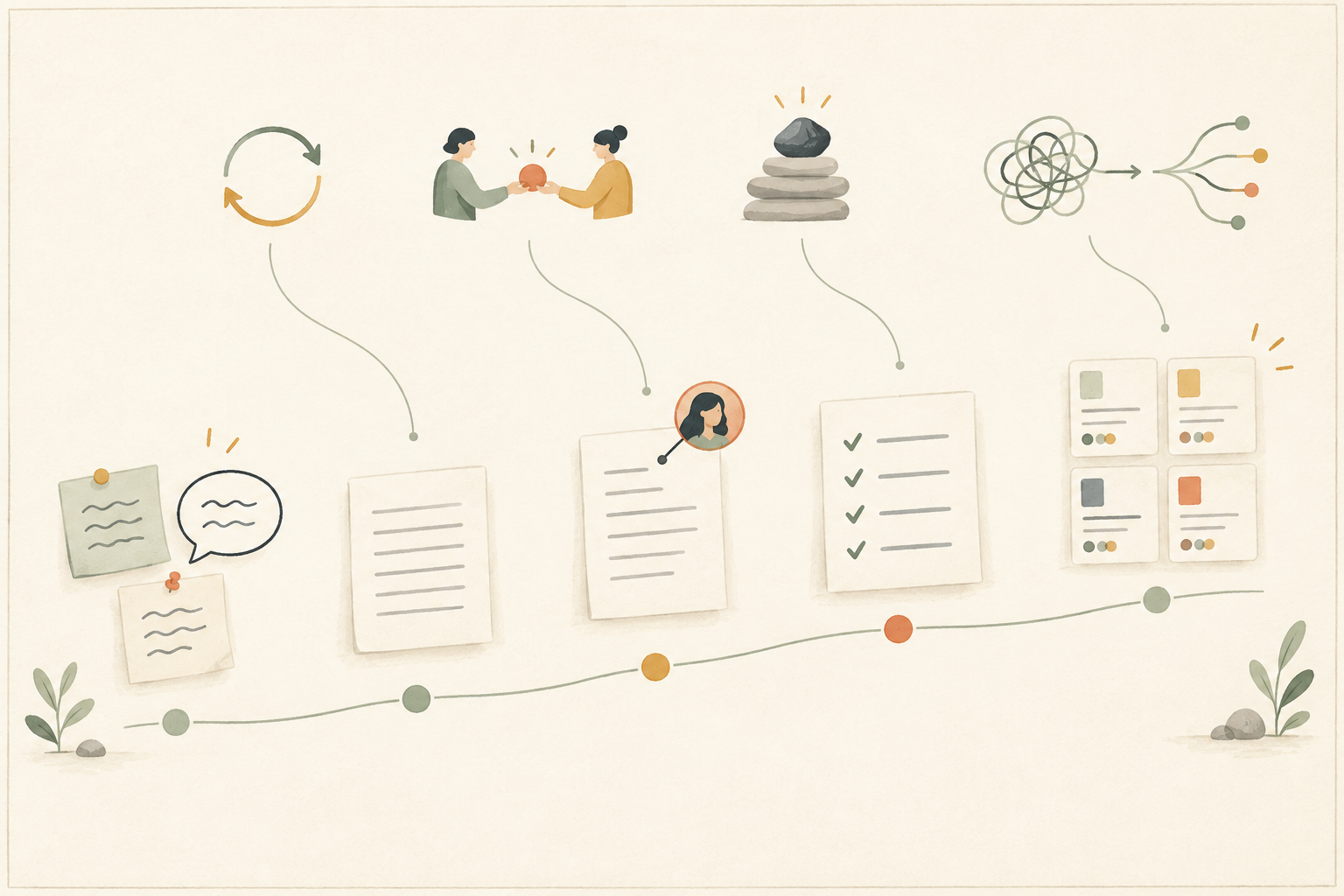

Use this as an escalation ladder:
You can stop anywhere. These layers can also overlap. A checklist may live on the same page as the guidance, while an owner keeps both current. Add a layer only when it addresses an observed failure.
Keep work informal when it is rare, completed by one person, inexpensive to get wrong, and easy to reverse.
Suppose a founder occasionally sends a low-stakes community update. If recreating the approach takes ten minutes and mistakes are easy to fix, maintaining a formal publishing procedure creates more work than it saves.
Consistency for its own sake is not much of a benefit.
A short shared page helps when teammates repeatedly need the same context, instructions, definitions, or decisions.
For a launch announcement, the page might contain:
Keep the page short enough that someone will read it. If you are unsure whether the team needs a policy, process, or detailed procedure, use this guide to choose the right kind of document. You can also organize project documentation around the work it supports.
Ownership helps when several people contribute but nobody keeps the recurring activity moving.
For onboarding, one person might make sure preparation starts, the right teammates complete their parts, and outdated guidance gets corrected. That is coordination. It does not require turning every contribution into another approval.
Name one owner for the recurring activity. Individual tasks can still belong to other people.
Use a checklist when people understand the work but routinely forget critical steps or complete them in the wrong order.
A pre-publish checklist might include confirming the final link, checking customer-facing details, obtaining a required approval, and assigning someone to monitor responses. It should protect known points of failure, not narrate every mouse click.
If a checklist keeps growing, move explanatory material into the supporting page and remove steps that no longer prevent mistakes. A checklist should remain usable. It does not need to contain the complete history of civilization.

This approach works in a shared document or any suitable tracking tool. In Notework, a team can begin with a page inside the relevant project.
A Notework workspace contains projects, and every page and collection belongs to a project. Each workspace and project has a home, which gives current guidance an obvious place to live.
Use a page to write or organize a lightweight runbook, decision note, or checklist. Add a collection when numerous instances need consistent properties such as an owner, status, or date. Collections are structured sets of full entry pages, and saved views provide different ways to see the same entries.
For example, a “Launch process” page can sit beside a collection of announcements. Each announcement opens as a full entry page, keeping its brief and block-anchored comments alongside its owner, status, and publication date.
Notework also includes Task Tracker and Issue Tracker collection presets, allowing actionable work and incident follow-up to sit beside the documentation that explains them. It is a simpler, more opinionated workspace for small teams that want documentation and day-to-day work together without maintaining an elaborate Notion-style workspace. For the broader case for keeping written context close to actionable work, see why docs and tasks should live in the same workspace.
Start with the failure you want to prevent. Add the smallest intervention that would have prevented it, then watch the next few instances. If the work becomes dependable, stop adding structure. If a step no longer helps, remove it.
If that work belongs in a calmer shared workspace, start a 14-day free trial of Notework. Every new workspace gets Team-level access during the trial.
See also organize project documentation.
See also document decisions so your team can find them later.
See also what to include in a project overview.
See also why docs and tasks should live in the same workspace.
See also when a workspace gets too flexible.
Structured tracking becomes useful when the team handles many similar items and repeatedly needs answers to questions such as:
Customer requests, onboarding work, recurring issues, and expense approvals can reach this point. Every field should answer a real coordination question. A 47-column tracker is technically a system. So is a junk drawer.
An occasional, easily corrected post can stay informal. A recurring launch involving several people has more handoffs and greater customer-facing risk.
Start with a brief page and one owner. Add a short pre-publish checklist if links, claims, approvals, or timing are being missed. Structured tracking becomes worthwhile only when the team is coordinating several announcements and needs to compare their owners, dates, and statuses.
Onboarding repeats, crosses several people, and can create costly confusion when access, expectations, or introductions fall through the cracks.
Use a maintained onboarding page for shared guidance and a checklist for each hire. Preserve room for role-specific judgment. A designer and an operations lead do not need identical onboarding beyond the parts they genuinely share.
Chat works for immediate coordination. It is a poor long-term record when the thread contains all the context, ownership, decisions, and promised follow-up.
Create a consistent issue entry when those details regularly disappear. Track the owner and status, then keep investigation notes and customer context with that instance. Minor questions can still stay out of the issue workflow.
Financial cost and limited reversibility can justify structure early. A small team may need only a written threshold explaining which spending requires approval, one named approver, and a lightweight record of the request and decision.
That is enough for many recurring purchases. Designing a grand procurement council for three software subscriptions would be a bit much.
Review a process after a failure, a team change, repeated confusion, or a meaningful change in the work. A scheduled review can help, but do not add a monthly meeting solely to admire the checklist.
For every step, field, approval, and recurring meeting, ask:
Delete inherited paperwork that no longer protects against a meaningful risk. If recurring work has begun filling the calendar, read how to build an operating rhythm without filling everyone’s calendar.
A process can also move down the ladder. A tracker might become a checklist when volume drops. A checklist can become a paragraph on a page once the habit is established. Removing structure does not mean the earlier decision was wrong. The work changed, so the process should change with it.