
Management by Exception: How to Run an Exception-Based Operations Review
Updated Nov 19, 20269 min read
Management by exception means managers focus attention on material deviations from normal performance while owners handle routine work within agreed boundaries. In a small-team operations review, that means bringing forward changes that need a decision, support, escalation, or committed follow-up instead of reciting everything that is on track.
The approach still depends on dependable ownership, clear expectations, and ordinary updates. Managers need context and regular conversations with their teams. Live review time can then go to the work that needs management attention.
An exception is a material change, threshold breach, risk, blocker, or unresolved decision that exceeds normal owner-level handling.
A metric moving up or down does not automatically qualify. Neither does an ordinary green update. An item deserves review when someone needs to decide, intervene, provide support, accept a tradeoff, or commit to follow-up.
Consider a campaign scheduled to launch on Tuesday. These updates can stay asynchronous:
The situation becomes an exception when legal approval will miss the launch date and the owner needs a decision: delay the campaign, launch without one channel, or change the scope. That kind of scope and date tradeoff may also call for project change control.
A short policy might ask owners to raise:
These are starting categories, not a universal standard. Adapt them to the work your team runs. Avoid turning every project field into an escalation rule. A 47-rule exception policy is just a status report wearing a fake mustache.
Start by writing down what normal looks like. Plain language usually works better than an elaborate reporting system.
| Area | Normal condition | Raise an exception when |
|---|---|---|
| Delivery | The owner expects to meet the committed date | The date is likely to slip, or scope must change to protect it |
| Blocked work | The owner can resolve the blocker through normal coordination | The blocker needs leadership support or threatens another commitment |
| Customer impact | Feedback can be handled through the usual process | A signal is unusual, consequential, or needs a coordinated response |
| Decisions | The owner has authority and enough context to decide | A tradeoff exceeds the owner's authority, or the decision deadline is at risk |
For every threshold, specify who raises the exception, when they should raise it, and where they should record it. Do not force people to wait for a numeric threshold when the consequences are already obvious. Judgment belongs in the system too.
Teams that use labels such as blocked, at risk, and off track should give those labels consistent meanings. The project status definitions guide offers a practical starting point.
The owner should submit a compact written brief before the meeting. It needs enough context for others to understand the variance and prepare for the requested decision.
A useful format is:
Exception: What changed?
Expected versus actual: What was supposed to happen, and what is happening now?
Impact: Which commitment, customer, date, cost, or piece of work is affected?
Recommendation: What does the owner think the team should do?
Request: What decision, support, or escalation is needed?
Owner and next step: Who will act, and what happens after the review?
Include links to the relevant project material rather than copying all the background into the brief. Healthy work and routine progress can remain in the normal written update. For help improving those updates, see how to write an async project update.
A routine update might say:
The launch may be delayed because legal has not approved the new claims. We are following up and hope to hear soon.
That warns the reader but leaves the meeting to discover the actual issue.
A useful exception brief says:
Exception: Legal approval for two homepage claims will miss Monday's launch cutoff.
Expected versus actual: Approval was due Friday. Legal can review the claims on Wednesday.
Impact: Waiting moves the launch to Thursday. Removing the claims preserves Monday's date but requires revised copy and design work.
Recommendation: Remove the claims and keep the Monday launch.
Request: Approve the scope change today.
Owner and next step: Priya will send revised copy to design after the review. The final page is due Friday.
Now the meeting has a tradeoff to resolve. The owner has already stated the variance, impact, recommendation, and request.
Review submitted exceptions before the meeting. Combine duplicates when several briefs describe the same underlying problem, then order the remaining items by consequence and decision deadline.
During the review:
Explicit deferral matters. “We'll come back to this” is how decisions wander into the woods. Record who will gather the missing information, when it is due, and when the decision will return. If your team has recurring uncertainty about who gets involved, write an escalation path before the next review.
An exception review should fit within the team's wider update and meeting cadence. It cannot carry every planning, relationship, and coordination need by itself. The guide to building an operating rhythm explains how recurring reviews can work alongside asynchronous updates and other meetings.
Meeting notes often become a second, poorly maintained version of the project. Avoid that split by recording each outcome beside the affected work.
Capture:
Link the exception brief to the project plan, brief, task, issue, or other material it changed. If the team decides to cut launch scope, update the launch plan too. A meeting note does not help much when the active plan still says the opposite.
A project log can help preserve the sequence of changes, decisions, and follow-up without making the exception review itself responsible for every piece of project history. For meeting outcomes specifically, a good meeting recap turns decisions into owned work.
Management by exception can fail in two directions. A manager may disappear from routine work until something breaks, or use every exception as an invitation to take over.
Managers still need to understand current commitments, make escalation safe, and remain available before a threshold is breached. Owners should not have to conceal early concerns because only confirmed failures are considered review-worthy.
When an exception arrives, start with the owner's request and recommendation. Ask what support or authority is missing. Taking control of the work may occasionally be necessary, but it should not be the default response to someone raising a risk. Otherwise, people learn that escalation costs them ownership, and bad news starts arriving late.
Review the policy after several cycles and whenever the team's commitments change. Look at what entered the review and what should have entered but did not.
Revise a category or threshold when:
Remove rules that create noise and clarify vague ones. If owners consistently need help before a formal threshold is crossed, change the policy rather than asking everyone to pretend the old threshold works.
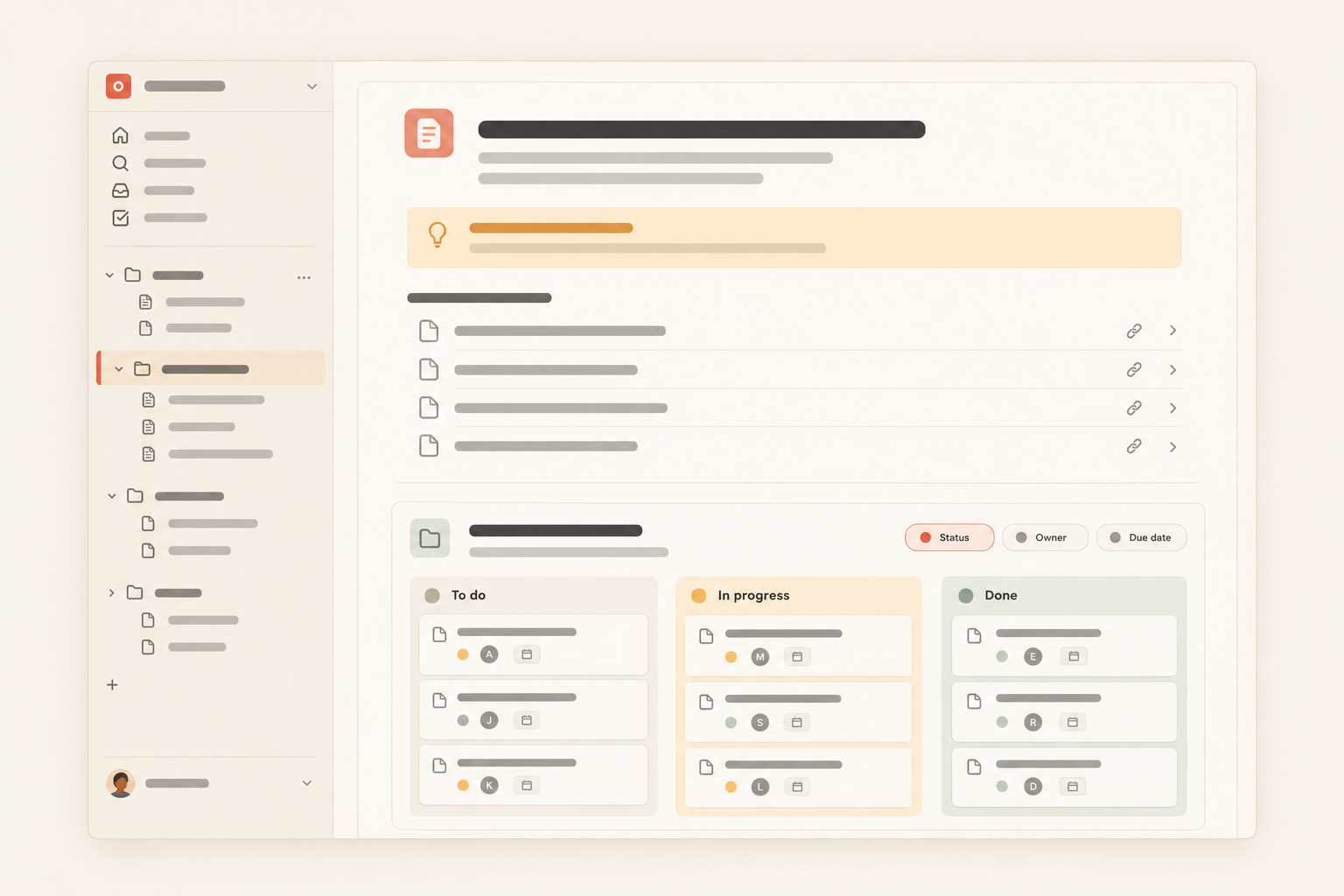
This workflow can run in any suitable shared workspace. In Notework, a workspace contains projects, and every page and collection belongs to a project. A team can keep an exception-review page beside the plans, briefs, and decisions affected by the review.
Use a page for the review pre-read and written exception briefs. When follow-up needs repeatable ownership, status, priority, or due dates, use a collection. Notework collections are structured sets of full entry pages with typed properties, so each task or issue can keep supporting context with the work.
Task Tracker and Issue Tracker collection presets support structured follow-up beside project documentation. Saved views show the same entry pages in different ways, such as by status, owner, priority, or date. Views support Table, Board, List, Calendar, Timeline, and Gallery formats, along with filters, sorts, grouping, and visible properties.
Comments are anchored to blocks on pages and entry pages. That gives teammates a place to discuss a recommendation or decision without turning the entire review page into one large conversation.
Notework is a simpler, more opinionated workspace for small teams that want documentation and day-to-day work together with less setup and maintenance. It keeps the review material and follow-up close to the project, while the team still decides what counts as an exception and what action to take.
Choose one recurring review that currently spends too much time narrating healthy work. Agree on a few exception categories, describe the thresholds in plain language, and ask owners to submit exception briefs beforehand.
Run the process for several cycles. Keep the categories that lead to useful decisions or support. Rewrite the rules that produce noise. A small policy people understand will do more useful work than an impressive framework nobody can remember.
See also turns decisions into owned work.
See also project change control.
See also write an escalation path.
See also keep a project log.
See also project health assessment.