
How to Hand Off an Active Project Without Writing a Small Novel
Updated Oct 14, 202611 min read
A useful project handoff passes a simple test: can the incoming owner sit down on Monday morning, understand what needs attention, and make a sensible decision without calling the previous owner every 20 minutes?
This guide is for an active internal project whose ownership is changing while the work continues. The new owner needs the current state, the next obligations, the judgment behind unresolved choices, and a reliable path to the live work.
The best format is usually one compact handoff page inside the project. It gives the incoming owner a map without becoming a second project tracker that starts going stale before the walkthrough ends.
An active-project handoff is different from project closeout, construction turnover, or employee offboarding.
The Association for Project Management recommends treating handover as an incremental transfer of knowledge, rather than a document assembled at the last minute. Write the handoff early enough to review it together, expose gaps, and answer questions.
A document drop at 4:52 p.m. on someone's last Friday is technically a transfer. So is leaving a house key under a flowerpot. Neither is especially reassuring.
The handoff page should stay compact and point outward to live project work. That principle drives everything that follows.
Open with a candid snapshot. The incoming owner should be able to read the first few paragraphs and understand:
Keep this section time-bound. A standing project overview explains what the project is and how it works. A handoff explains what is happening at the moment ownership changes.
For example:
The launch is scheduled for the end of the month. Product work is complete, but final creative approval is running late. The most urgent job is getting the revised campaign assets approved by Thursday so the launch schedule remains workable.
That is more useful than three pages of background followed by “Status: amber.” If the project goal has changed, say so. If confidence is low, say that too. The new owner needs an accurate starting point, not a ceremonial display of optimism.
The first week matters more than the first six months of project history. List the obligations coming up during the next one to two weeks:
Write commitments so another person can act on them.
“Follow up with design” is vague. “Maya will send revised launch graphics by Thursday; Jordan must approve them before Friday's campaign review” establishes ownership, timing, and sequence.
Link each commitment to its maintained task, brief, issue, or plan. The handoff page should explain why the commitment matters, while changing details stay with the live work. If the team needs to decide whether something belongs in a task or an issue, see task vs. issue.
Statuses tell the new owner where something sits. They rarely explain how it got there or what should happen next.
Record unresolved decisions and the context needed to make them:
Compare these two notes:
Launch is mostly on track. Pricing needs discussion.
The launch date still looks achievable. The open decision is whether to keep introductory pricing for the first month. Finance prefers the standard price; sales expects introductory pricing to help current conversations. Priya owns the decision and needs to confirm it before final copy is approved on Thursday. See the linked pricing note for the options already discussed.
The second version identifies the choice, the people involved, the deadline, and the consequence without narrating every meeting.
A useful decision note can carry this context after the handoff. If you need a broader system for preserving reasoning, document decisions so your team can find them later.
Skip the generic risk-register performance. Include risks the incoming owner can monitor, reduce, or escalate.
For each meaningful risk, explain:
A useful note might read:
Final creative depends on legal review. If comments are not back by Wednesday afternoon, tell the marketing lead immediately because the campaign schedule will need to change.
Stakeholder context belongs here when it affects how the work should be handled. Perhaps a department lead wants to review customer-facing language personally, or an external partner needs more notice than the project plan suggests. Keep it factual and relevant. A handoff is a work document, not a collection of private character reviews.
Separate orientation from operations.
The handoff page should contain relatively stable context:
Leave changing operational details in the places where the team already manages them:
Copying all of this creates two sources of truth. One gets updated, while the other quietly becomes historical fiction.
Treat the handoff page as a map. It should tell the new owner which sources matter and why, without reproducing every road. For more advice on keeping those supporting materials findable, see how to organize project documentation.
A compact handoff might look like this:
Current state: Product work is complete, and the launch remains scheduled for the end of the month. Final campaign creative is late. Approval by Thursday is the immediate priority.
Next commitments: Maya sends revised creative on Thursday morning. Jordan approves it that afternoon. The new project owner runs Friday's campaign review and confirms whether the schedule still holds.
Open decision: Priya must choose between standard and introductory pricing before final copy approval. Finance and sales have different preferences. The pricing decision note contains the options and prior discussion.
Risk: Legal review may delay creative approval. Escalate to the marketing lead if comments are not returned by Wednesday afternoon.
Stakeholder watch-out: Sales needs the final pricing and launch date before updating active customer conversations.
Live work: Launch plan, campaign brief, active task list, open issues, pricing decision note, and final creative review.
This is short enough to read before a meeting. The linked material carries the detail.
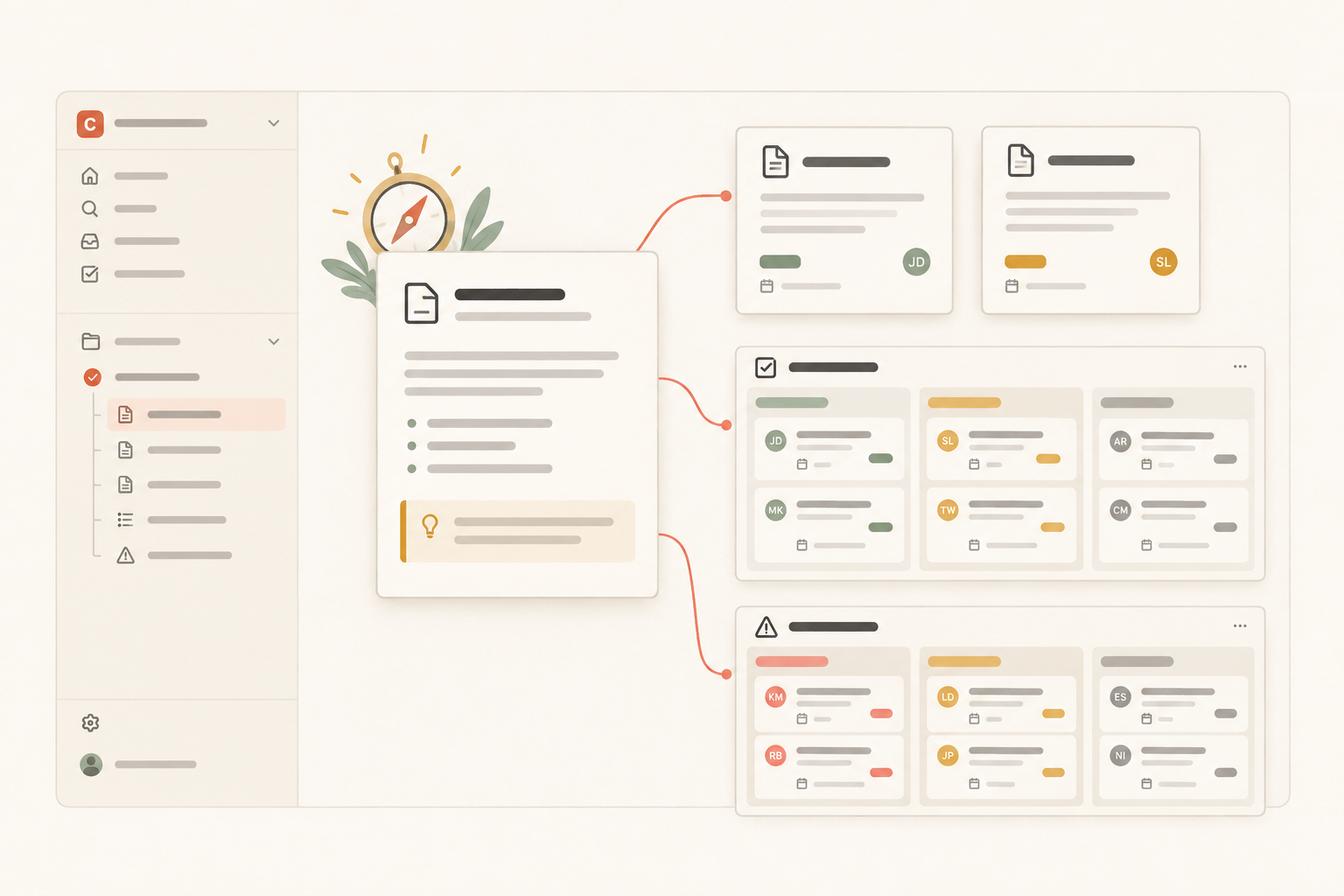
The handoff works best when it is part of the same project structure as the work it describes. In Notework, that means placing one handoff page in the relevant project and linking it to the pages and collections that carry the changing details.
A Notework workspace contains projects, and every page and collection belongs to a project. Each project has a home, giving the incoming owner a clear place to start instead of another loose document in a general workspace.
Use the handoff page for current state, reasoning, stakeholder notes, risks, and links. Briefs and decision notes can remain separate linked pages. Pages support nesting, mentions, backlinks, and comments anchored to specific blocks. If the incoming owner questions one risk statement, they can comment on that block rather than start a vague discussion about the whole page.
Use a collection when active work needs repeatable structure. Notework collections are structured sets of full entry pages with typed properties and saved views. The Task Tracker and Issue Tracker presets can hold changing ownership, status, priority, and due dates alongside the project documentation.
The division is straightforward:
This is the practical reason to keep the handoff compact. The page gives the new owner a starting point, while the project keeps the live work in its proper place. Do not copy every task into the handoff page. Link to the relevant collection or entry pages, then summarize only what deserves attention first.
Book a short walkthrough before responsibility changes. Both owners should review the current state, near-term commitments, open decisions, risks, and important links.
Let the incoming owner drive part of the conversation. Ask them to explain their first action and identify anything they still cannot decide from the available context. This reveals gaps faster than asking, “Does that all make sense?”
A short meeting recap can capture questions and follow-up work that emerge during the walkthrough. Keep those follow-ups connected to the live project work instead of adding them only to the handoff page.
After the walkthrough:
The handoff page supports the transfer. Visible ownership completes it.
Before considering the transfer done, check:
If the answer to the first question is no, the handoff needs another pass.
Copy this structure and remove sections that do not apply:
## Project and ownership
- Project:
- Departing owner:
- Incoming owner:
- Ownership changes on:

## Current state
- Goal:
- Current phase:
- What is on track or off track:
- Most important thing to understand first:

## Immediate commitments
- Commitment, date, owner, and link to live work
- Incoming owner's first action
- Upcoming approvals or meetings

## Key people
- Person, role in the project, and when to involve them

## Open decisions
- Decision needed:
- Decision owner and deadline:
- Relevant reasoning or tradeoffs:
- Link to decision material:

## Risks and dependencies
- Risk or dependency:
- Warning sign:
- Response or escalation point:

## Live project material
- Project plan:
- Tasks:
- Issues:
- Briefs and requirements:
- Decision notes:
- Relevant conversations:
A small project may need only half of this. Complex work may require more supporting material and a longer conversation. The page has done its job when the incoming owner can act, exercise judgment, and find the changing work without reading a small novel first.
If you use Notework, start with one handoff page in the project, then link it to the task and issue collections and supporting pages that already hold the work. That structure keeps the transfer focused on what the new owner needs now, instead of asking them to inherit an entire archive.
See also project overview.
See also meeting recap.
See also task vs. issue.
See also organize project documentation.