
How to Use a Now, Next, Later Roadmap as a Confidence Model
Updated Oct 14, 202611 min read
A roadmap becomes hard to trust when uncertain ideas look as committed as active work. Dates can make this worse. A rough possibility quietly becomes a promise because someone put “October” next to it.
A Now, Next, Later roadmap groups initiatives into three relative planning horizons. Used well, those horizons show how much the team knows and how prepared it is to commit. Now contains owned work with an active next step. Next contains plausible options that still need shaping. Later preserves direction without pretending the details are settled.
The format is simple. The operating rules make it useful. A collection with a Horizon property and several saved views can make those rules visible in day-to-day work, too.
A date-based roadmap places work against months, quarters, or release dates. A Now, Next, Later roadmap communicates relative planning horizons without requiring a fixed delivery date for every initiative.
That makes the format useful when evidence, priorities, or capacity may change. It keeps the discussion focused on strategy: what the team has committed to, what it may pursue, and what remains directional.
Date-free planning still leaves room for real dates. A contractual deadline, scheduled launch, regulatory requirement, or external event may need one. Keep that constraint attached to the relevant initiative. The roadmap simply avoids precision where the team does not have it.
Placement should reflect a change in confidence, evidence, or commitment. An item does not move from Later to Next because it has been sitting there for six weeks. It moves when the team has a reason to learn more and is willing to spend attention on shaping it.
Initiatives should gain detail as they approach commitment. Distant work stays broad. Near-term work becomes specific enough to act on.
| Horizon | Commitment | Ownership | Useful detail | Acceptable uncertainty |
|---|---|---|---|---|
| Now | The team has committed | Accountable owner | Intended outcome or bounded scope, context, active next step | Known questions may remain, provided work can begin |
| Next | A plausible candidate | Likely owner or shaping owner | Rationale, proposed outcome, evidence, open questions | Meaningful questions remain and are stated clearly |
| Later | Directional possibility | Optional | Opportunity, theme, or proposed outcome | Scope, approach, and timing may all change |
An initiative belongs in Now when the team can answer four questions:
Some uncertainty can remain. A team may still need to test an implementation approach or resolve a design question during delivery. Those unknowns should be visible and understood. A missing decision that prevents anyone from starting belongs back in Next.
Keep Now small. It represents meaningful initiatives the team has committed to, rather than every task currently assigned to someone. If the column contains 26 cards covering bug fixes, copy edits, research calls, and a product launch, you have built a task board wearing a roadmap costume.
Next holds work the team could reasonably choose soon. It needs enough information for a useful decision without implying that delivery is guaranteed.
A useful Next entry usually includes:
“Improve onboarding” is too vague. A stronger entry might say that new workspace owners have difficulty reaching the first useful setup, with open questions about where they stop and which guidance would help. The next decision could be whether the evidence supports changing the setup flow.
Keep Next selective. It should contain credible candidates, not every request that nobody wants to reject.
Later preserves opportunities, themes, and proposed outcomes that are worth remembering but premature to shape.
Record the opportunity and enough rationale to explain why it exists. Detailed estimates, task breakdowns, and precise scope tend to decay before anyone uses them. They can also make an early idea look approved.
A Later entry might say, “Make recurring operational reviews easier to run,” followed by a short note about the observed need. It probably does not need a six-part delivery plan. Nobody wins a prize for estimating work that may be reconsidered twice before it begins.
Roadmap movement should reflect a change in evidence, priority, or commitment. Write the criteria down so a persuasive meeting does not become the whole prioritization system.
Promote an initiative when:
Moving to Next authorizes attention. Delivery still requires a later commitment decision. If nobody will investigate the opportunity or make the next decision, leave it in Later.
Before promotion to Now, require:
Perfect information is unnecessary. The team does need to understand and accept the remaining uncertainty. “We still need to choose between two technical approaches” may be manageable. “We do not know who this is for or why it matters” calls for more shaping.
Backward movement keeps the roadmap honest. Demote an initiative when a dependency blocks meaningful progress, evidence weakens, capacity changes, or another priority becomes more pressing.
Merge entries that describe the same outcome. Remove requests that no longer support the strategy. Move small delivery tasks out of the roadmap entirely. The distinction between a roadmap initiative and a delivery task is worth making explicit. See project vs. task for a useful way to separate the two.
Deletion is a roadmap decision too. A Later column containing years of abandoned suggestions mainly communicates the team’s reluctance to use the delete button.
Use one roadmap entry for each meaningful outcome, investment, or bet. Track the tasks and issues required to deliver it elsewhere, linking them back when useful.
For example, Reduce failed invoice recovery could be a roadmap initiative. Investigating an error state, revising an email, and fixing a retry bug are delivery work within that initiative. Putting all four on the roadmap makes the larger intent harder to see.
Tasks and issues may both support an initiative, but they usually need different handling. A task describes work someone intends to complete. An issue describes a problem that needs investigation or resolution. This task vs. issue guide covers the distinction in more detail.
A few practical limits help:
A three-column task dump is still a task dump. It is merely arranged horizontally.
A monthly review works for many teams. A weekly review may make sense during an active planning period, while a quarterly review may be enough for a steadier portfolio. Review the roadmap after a meaningful change in strategy, evidence, dependencies, or available capacity regardless of the normal cadence.
During the review, ask:
The review should produce a decision: a moved initiative, a named owner, a shaping question, a demotion, or a removal. Reading every card aloud is a status recital, not a roadmap review. Keep the routine small enough that the team will actually repeat it. Minimum viable process is a useful principle here.
Consider an initiative called Improve mobile issue capture.
In Later, the entry records an opportunity: teammates sometimes notice problems away from their desks, and the team may want to make capture easier. The proposed outcome is broad. There is no estimate or detailed scope.
In Next, the team decides the opportunity deserves investigation. A likely owner is named. The entry links to relevant feedback and lists open questions: Which situations matter most? What information is essential at capture time? Does the evidence support changing the existing flow? The immediate work is shaping and decision-making.
In Now, the team has committed to a bounded outcome. An accountable owner is clear, the intended change is documented, and the first delivery step is active. Tasks and issues live in their appropriate trackers, linked back to the initiative.
The initiative keeps its rationale and history as it moves. Ownership, scope, and the next step become more precise.
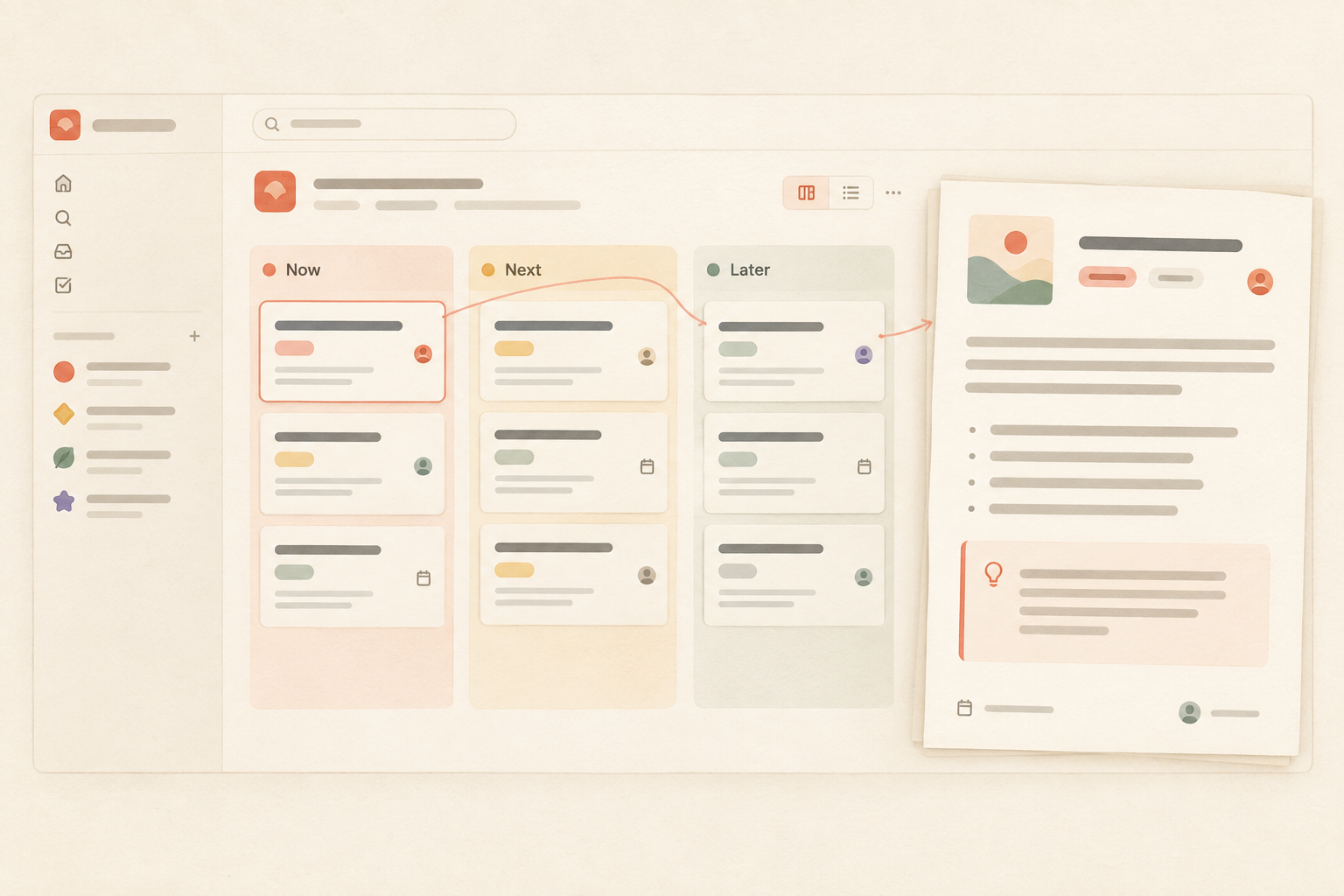
A board is useful for scanning horizons, but a card title cannot carry an initiative’s history. Each initiative should open into a fuller page containing its rationale, owner, open questions, decisions, evidence, and links to delivery work.
One practical setup is a collection with one entry page per initiative and a Horizon property containing Now, Next, or Later. Add an owner, intended outcome, and last reviewed date. Use a Board view grouped by Horizon for the main roadmap. A Table view can support review, while a Calendar or Timeline view can show genuine dates when they matter. The same entries remain the source of context across those views.
This keeps the board simple while preserving the information that explains why an initiative is where it is. It also makes the confidence model easier to maintain: changing Horizon moves the initiative between views without creating a second copy of the work.
Keep the rationale, evidence, open questions, decisions, and supporting links inside the initiative’s entry page. The guidance in what to include in a project overview can help keep that supporting context useful without turning the page into an archive of everything anyone has ever said about it.
This operating model works in any shared planning tool that can keep structured initiative details beside a board. Notework is one option for small teams that want roadmap context near related plans, notes, tasks, and issues without adopting a dedicated portfolio-planning system.
In Notework, a workspace contains projects, and every page and collection belongs to a project. Within the relevant project, create a collection with one entry page per initiative. Collections are structured sets of full entry pages with typed properties. Their saved views are different ways to look at the same entries, not separate datasets.
Notework supports Board, Table, List, Calendar, Timeline, and Gallery views. For this workflow, use Board grouped by Horizon as the main roadmap, then use another view when a different question comes up. A Timeline or Calendar view can display real dates attached to initiatives. It cannot turn an uncertain idea into a forecast.
Pages can hold the fuller context around an initiative. Notework pages support nesting, mentions, backlinks, and block-anchored comments, so plans, notes, briefs, and decisions can stay close to the work they explain. The included Task Tracker and Issue Tracker collection presets can hold delivery work separately from the roadmap.
Notework is a simpler, more opinionated workspace for small teams that keeps documentation, projects, tasks, issues, and structured information together. It is useful here because the collection expresses the changing confidence level while each entry page retains the reasoning behind it. The planning method still works without Notework.
Protect Now from casual additions. Make the unanswered questions in Next visible. Keep Later light enough that the team can revise or discard it without mourning a detailed plan that never had a chance to become real.
A credible roadmap shows what the team is prepared to do, what it is still deciding, and where its attention may go after that.
See also project vs. task.
See also turn decisions into owned work.
See also what to include in a project overview.
See also minimum viable process.