Requirements Traceability Without a Frozen Spec
Updated Oct 14, 202611 min read
A specification can look perfectly sensible at kickoff and become fiction two weeks later. A constraint surfaces during implementation. An edge case appears in review. Someone clarifies expected behavior in Slack. The task changes, but the specification stays untouched.
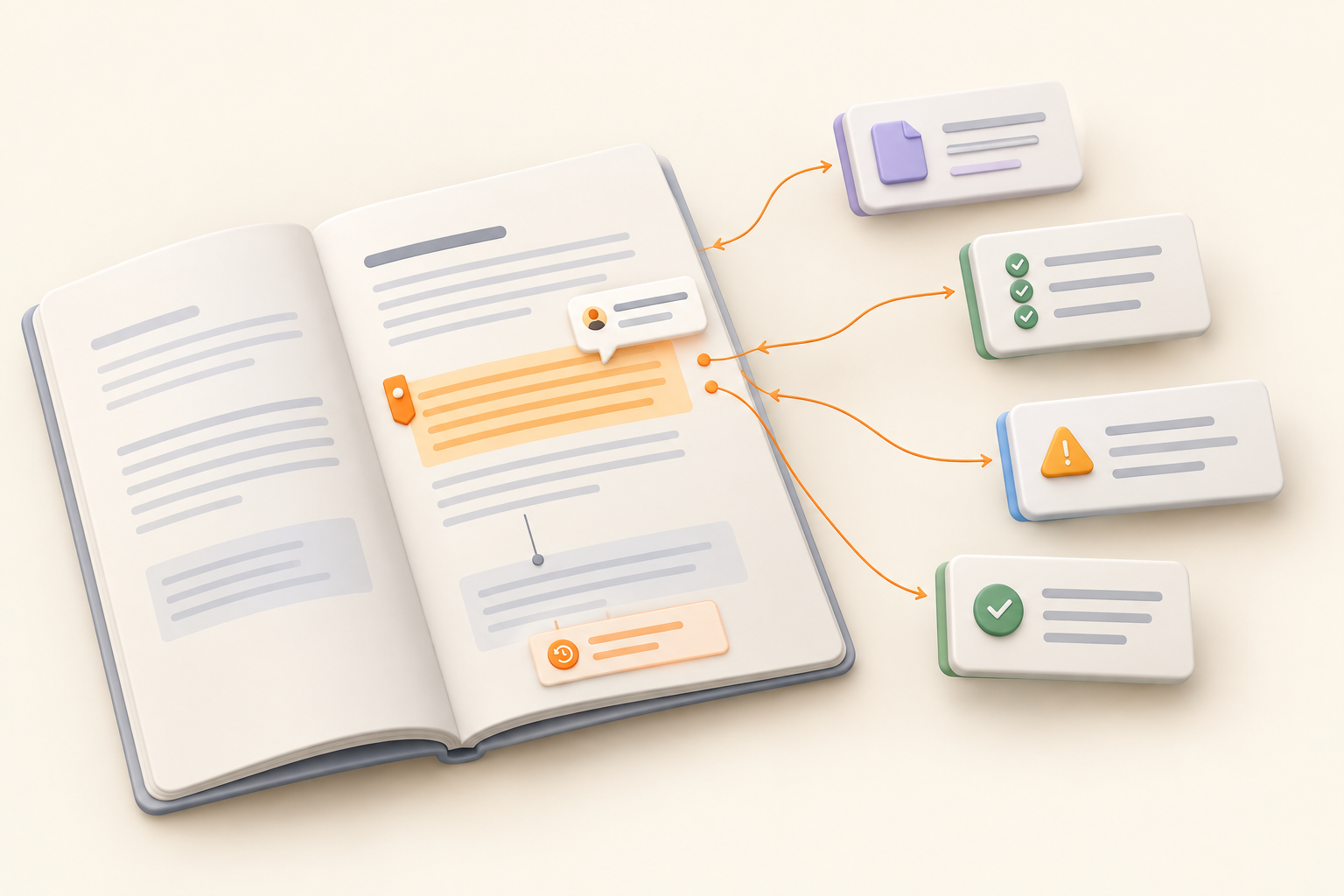
Requirements traceability helps expose that split by keeping visible links between what was requested, where it came from, the work that follows, and the decisions that change it. For a small team, useful traceability doesn't have to begin with a giant matrix. It can begin with a readable specification that is allowed to change.
Requirements traceability is the practice of linking requirements throughout their lifecycle, from their origin through development and testing. The IIBA describes traceability as documenting a requirement's lineage, including backward and forward traceability.
Backward traceability connects a requirement to its source. That source might be a customer need, contract, business objective, research finding, prior decision, or technical constraint. It answers a basic question: Why does this requirement exist?
Forward traceability connects the requirement to downstream design, implementation, testing, and validation work. It shows what the team did about the requirement and how the result was checked.
A formal traceability system may maintain these links in both directions. Someone reviewing a test can find the requirement it verifies, while someone reviewing the requirement can find its tests, implementation work, and evidence.
A requirements traceability matrix, often called an RTM, is one way to maintain those connections. The selected sources do not establish one mandatory matrix format. The appropriate format depends on the consequences of missing or changing a requirement.
This article focuses on coordination for evolving product and internal-project work. It does not replace formal traceability for regulated, safety-critical, contractual, or validation-heavy systems.
Many teams treat the specification as an input to delivery. They approve it, create tasks, and then move the real conversation elsewhere.
The implementation task gains a clarification. An issue report exposes a contradiction. A meeting changes the scope. Someone settles an edge case in chat. Each local update may be reasonable, but the original requirement remains unchanged.
Soon the team has two versions of reality:
Freezing the specification doesn't preserve certainty. It preserves old information.
A living specification handles this better. The team updates it when a decision changes expected behavior, while links to tasks, issues, and decisions preserve the path that led there. The specification remains the readable source of requirements instead of becoming a historical artifact everyone politely ignores.
A small team can begin with a bounded chain:
Requirement passage or stable label → linked task or issue → outcome, decision, or change note
Add the requirement's source or rationale when it isn't obvious. With those connections, a teammate should be able to answer:
This is selective traceability. It favors maintained links around consequential requirements over exhaustive links around every sentence. A minimum viable process is usually a better starting point than a matrix nobody has time to maintain.
Write the specification for humans first. Group related behavior, explain the context, and use examples where they remove ambiguity.
Give stable labels to requirements that could materially affect scope, cost, technical design, customer behavior, or risk. A short label such as CHK-04 can survive wording changes and gives tasks or issues something precise to reference.
Do not assign an identifier to every sentence because traceability sounds official. “The confirmation message uses the approved product name” probably doesn't need a miniature bureaucracy unless that wording has contractual or operational consequences.
Keep the tracked requirement in the readable specification. Maintaining one friendly version and a separate traceable copy creates another synchronization problem, which is a slightly absurd cure for a synchronization problem.
A Notework Page fits this job because the specification can stay as a document with nested pages, mentions, backlinks, history, and comments anchored to the relevant block. The requirement label is useful, but the surrounding explanation stays where people can read it.
Suppose a checkout specification includes this requirement:
CHK-04: If payment authorization fails, the customer can retry without re-entering shipping information.
The related work might include an error-state design task and an implementation task for preserving the shipping fields. Both should reference CHK-04, not merely “Checkout project.” The requirement should also make those related tasks easy to find through direct links or backlinks.
In Notework, those tasks can be full entry pages in a Task Tracker collection inside the same project as the specification. That gives each task room for context, links, and an outcome instead of reducing the requirement reference to a cell in a detached tracker.
That level of precision matters when someone changes the behavior. A broad project link tells you the task is somewhere in the neighborhood. A requirement-level reference tells you which house to knock on.
Issues are useful when implementation reveals that a requirement is incomplete or wrong. If the distinction is unclear on your team, this guide to the difference between a task and an issue is a useful companion.
Imagine the payment provider clears sensitive form state after an authorization failure. The team opens an issue linked to CHK-04, explains the constraint, and evaluates alternatives. They decide to preserve shipping information but require payment details to be entered again.
The team then updates CHK-04 in the specification, records the decision and its rationale, and revises or splits the linked implementation work. The issue stays connected to the requirement that exposed the problem.
Notework's Issue Tracker collection preset gives that investigation work a separate place from ordinary implementation tasks, while each issue remains a full entry page. A Relation property can provide a structured connection between related collection entries when that relationship is worth maintaining. It does not create automated impact analysis or coverage reporting.
The previous wording doesn't need to remain in the main body forever. Page history or a concise change note can preserve the trail. The current specification should remain easy to read.
When reviewers question wording, discuss it beside the relevant passage rather than in a detached meeting note or general chat thread.
Block-anchored comments keep the question attached to the text under review. They are useful for resolving temporary questions, but they are not a substitute for a durable decision. If a discussion changes scope or expected behavior, update the requirement and affected work.
A resolved comment containing the only accurate version of the requirement is just buried documentation with better manners.
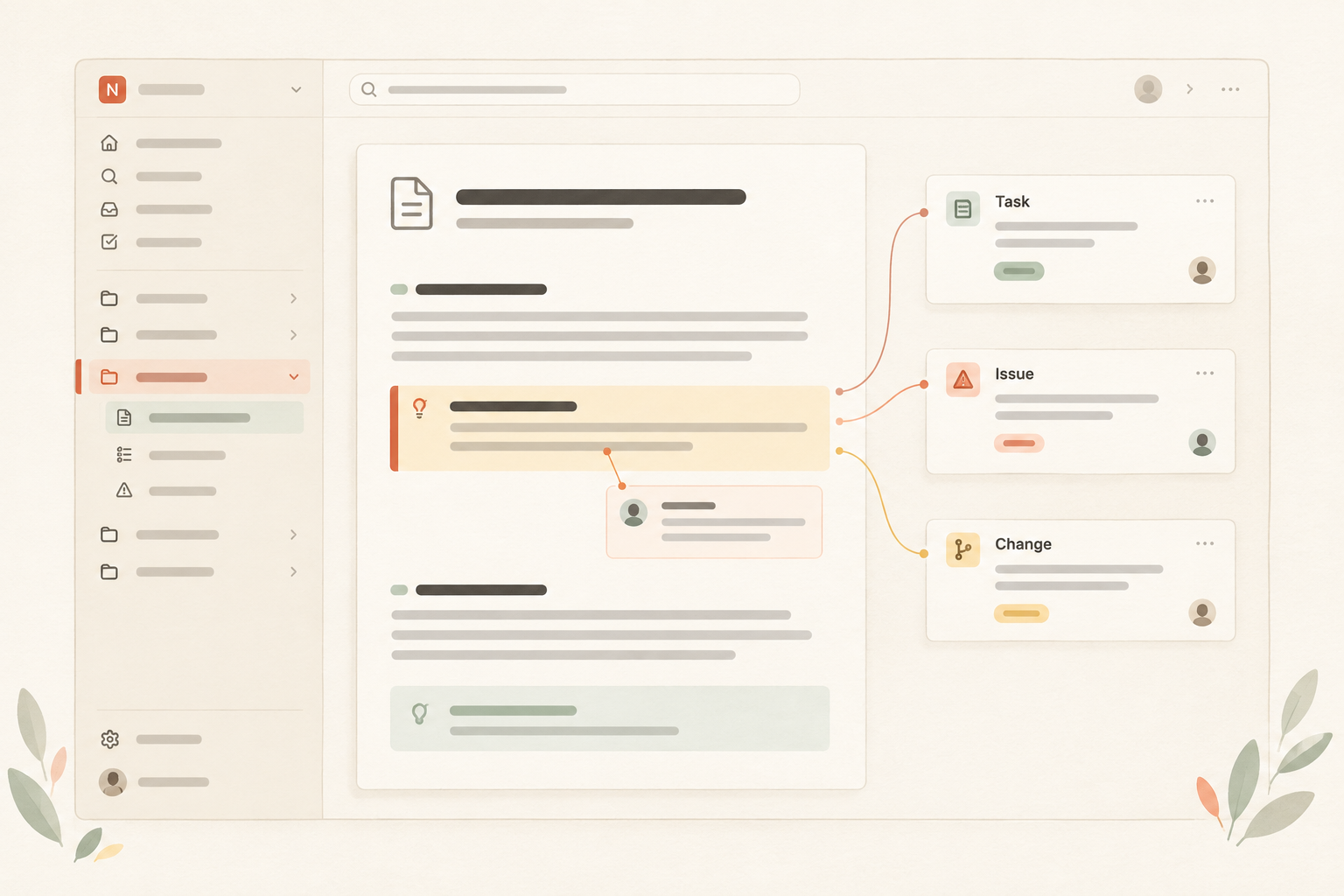
The product structure matters here because the traceability chain has to survive ordinary work. A Notework workspace contains projects, and every page and collection belongs to a project. That gives the living specification, its task work, and its issue work a shared boundary without turning the specification into a separate matrix.
Use one project for the feature or internal initiative. Put the specification in a Page. Keep implementation work in a Task Tracker collection and questions or contradictions in an Issue Tracker collection. Link each important requirement passage to the relevant entry pages, and use backlinks to move from the specification to related work and back again.
This is more specific than simply keeping documents and tasks together. The useful connection is between a requirement passage and the work that implements or challenges it. The same principle is explored in how to organize project documentation.
A practical project can contain:
Collections are structured sets of entry pages with typed properties. Each entry remains a full page, so the task or issue can hold investigation notes, relevant links, and the outcome. The Page and the collection entry are different objects, but they can be connected by links, backlinks, and, where useful, a Relation property.
Collection views are saved ways of looking at the same entries. A Board view might help manage task status while a Table view exposes requirement references. List, Calendar, Timeline, and Gallery views are available too. None of these creates a second dataset or automatically verifies that every requirement is covered.
The project home is where a teammate should be able to start. It can point to the current specification and the views used for execution. It should not become a dashboard-building project in disguise. If people need a separate document explaining where the project documents live, the structure probably needs another look.
This setup makes it easier to inspect the chain when a requirement changes. It does not provide automated bidirectional traceability, requirement coverage analysis, test-case management, validation evidence, or compliance reporting.
Traceability needs maintenance at the moment of change, not as a cleanup exercise before launch.
When a requirement changes:
In the Notework setup above, this means editing the Page, following its backlinks to related task and issue entry pages, and recording the decision where the team will find it later. The links are useful only if someone follows them when the requirement changes.
Completed work deserves attention too. A changed requirement may invalidate something the team already shipped or approved. Updating the source requirement without reviewing its links documents the change but reveals little about its impact.
This approach can suit teams coordinating changing product features, internal tools, operational processes, or similar work where the main needs are shared context and practical impact review.
Use a formal RTM, dedicated requirements-management tooling, explicit validation controls, and maintained test evidence when the work is:
Those settings often require complete bidirectional links, controlled baselines, formal change procedures, coverage reporting, and durable proof that each requirement was verified. A Page connected to tasks and issues should not be presented as equivalent.
Trace the requirements where ambiguity has consequences. Start with behavior that affects customers, scope, technical design, cost, risk, or a commitment someone expects the team to honor.
Give those requirements stable references. Connect them to the tasks that implement them and the issues that challenge them. When a decision changes the expected result, update the specification and review every linked piece of work.
Expand the practice when missing links repeatedly cause confusion. A selective chain that stays current is more useful than a comprehensive matrix last updated shortly after kickoff.
If you want to try this structure in practice, start a Notework workspace with a 14-day free trial and Team-level access during the trial. Use one project for the work, a Page for the living specification, and Task Tracker and Issue Tracker collections for the links that need attention.
See also project overview.
See also turn decisions into owned work.
See also a minimum viable process.
See also organize project documentation.